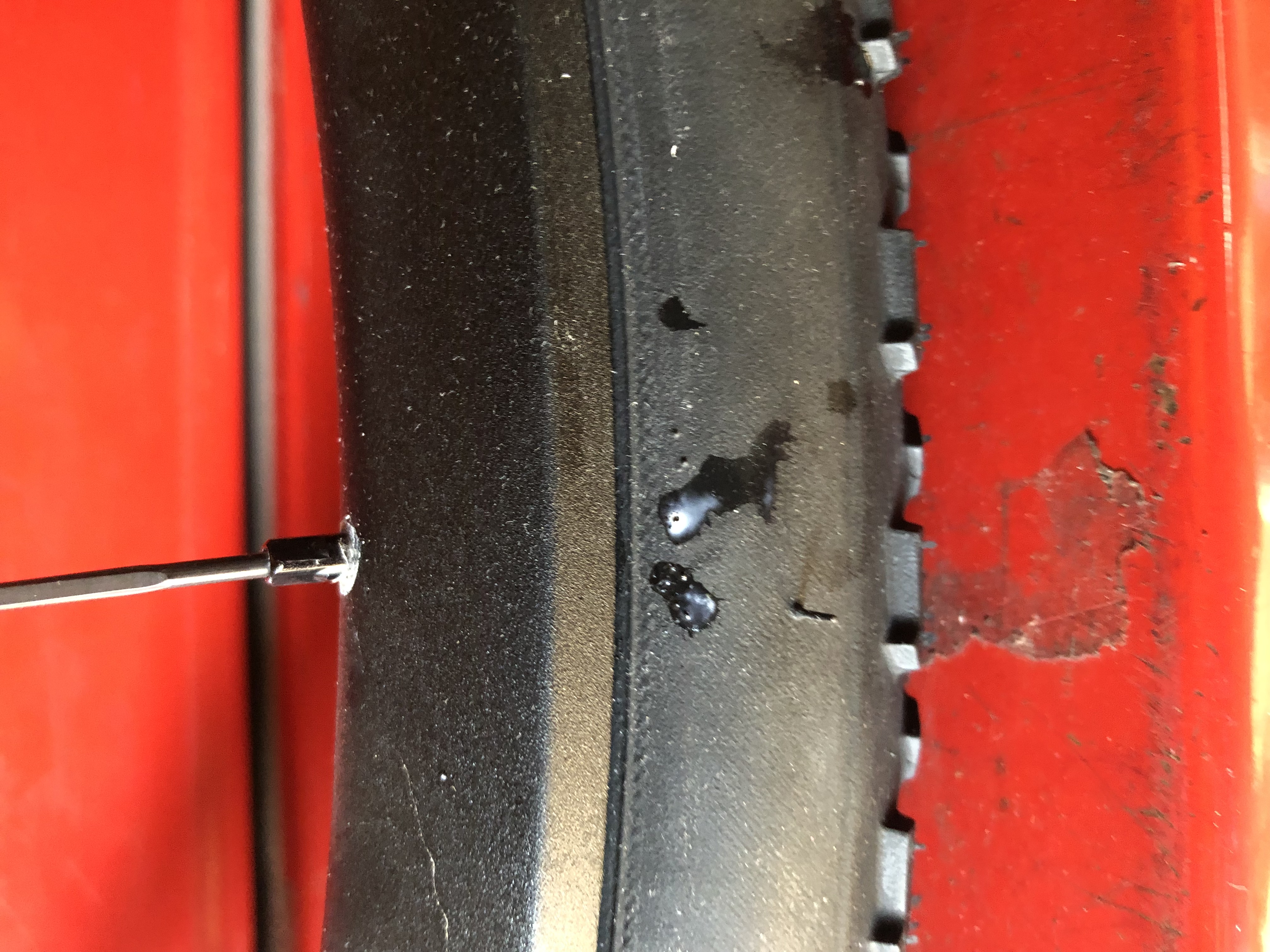
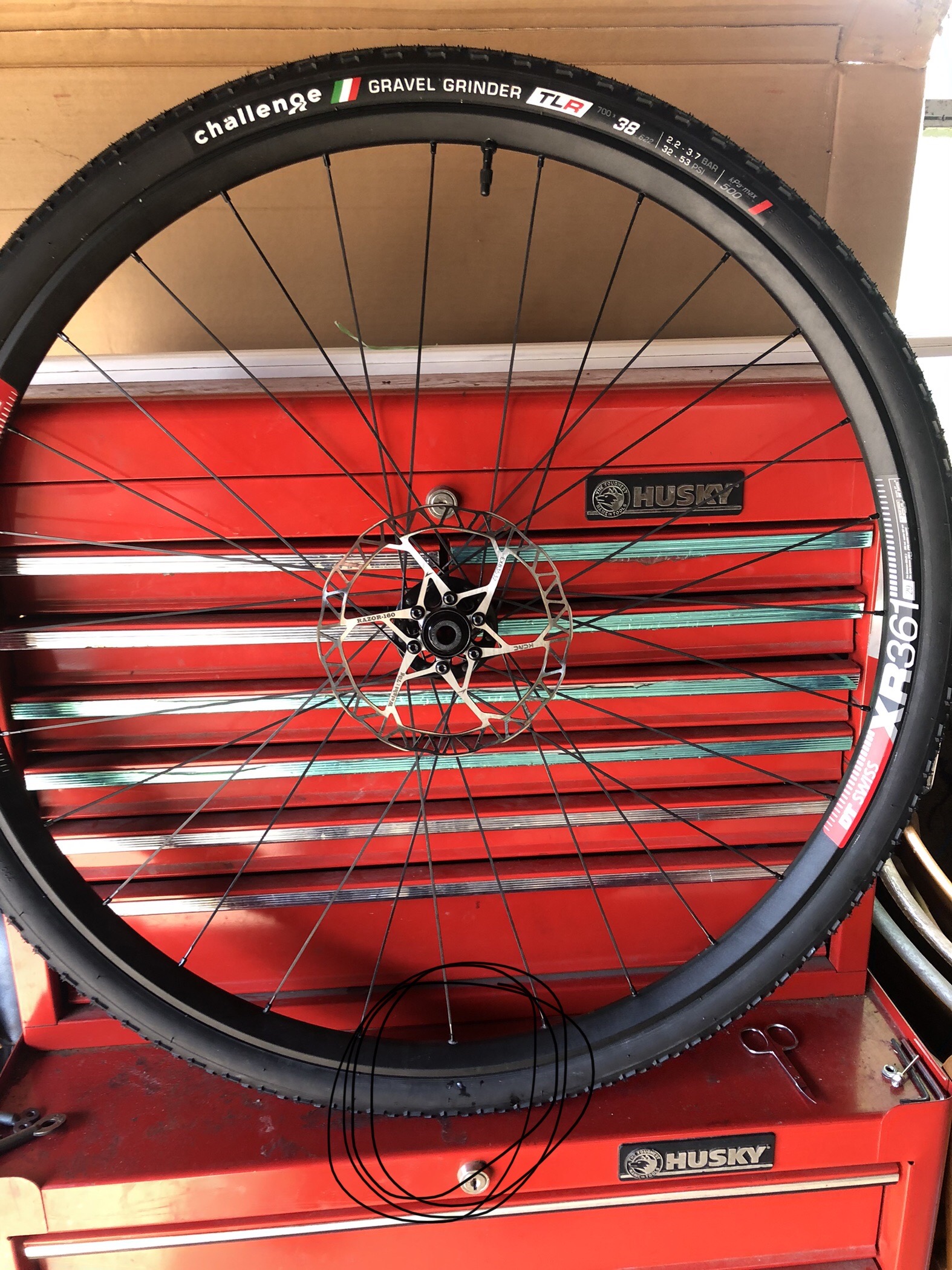
Hello everyone. What's your opinion of this sidewall?
These are new tires that I expect to have mounted for the long run. This either came punctured or I punctured them during an unconventional tubeless setup involving a ratchet strap - perhaps the buckle may have caused it.
The hole will seal at 40psi but the plug blows out at 50psi. Should I try and patch the inside (I've never done a sidewall) or should I purchase a replacement and go warranty route for this one.
This is my "gravel race" wheelset and I need it dead reliable.
Sidewall punctures cannot be reliably patched, flexing of the sidewall will cause the patch to eventually fail. This doesn’t just apply to bike tires, auto mechanics will not patch or plug a car sidewall puncture. So if you need it reliable, you need a new tire.
Patches are cheap though so you could try that. I'm sure it would help and last for a while as a training tire if you want to squeeze some more miles out of it.
the tire is sitting comfortable at 40psi. I will ride it at 35 or so. But with the sidewall flex I don’t have much faith in the sealant staying as a plug.
A friend told me to just patch it and ride on. Which is a decent idea except when it’s race day “accepted risks” need to be cut to a minimum.
I’ll get another on order and have it on hand. I’ll see if I can warranty this one and if not I’ll ride it out for the summer with a patch and/or tube.
I don’t think we’re racing in Ontario until the 2022 season anyways.
I wonder if Stans Darts would work. From my understanding, the darts reacts with the stans sealant and the dart vulcanizes with the tire. I did fix a sidewall cut that way from some sharp vegas rocks.
I agree with those who wouldn't depend on that tire in a race but if I couldn't get a warranty replacement I'd still use it for training. I'd try putting a Rema patch on the inside of the tire - those patches last forever on tubes and the air pressure would be pressing the patch toward the hole rather than away.
I think the situation is different with car tires. Those have thick treads with steel belts which don't flex much so plugs stay in. However the sidewalls are thin, flex more cycles than bike tires, and can run at high temperatures. In a supple bike tire there's not much difference between the tread and the sidewall.
Hmmm...gotta disagree somewhat: Auto radial ply tires sidewalls flex HUGELY (look at one when parked; it sits way more than our standard 15% drop), and because most sidewall punctures are slices or scrapes that cut these fibers and belts, all but the most secure vulcanized patches will eventually fail. Hence they're illegal in many places. My cycling experience of late is only with very supple, thin sidewalls, where there just isn't much there to adhere to. Nonetheless, the much lower speeds and temps may allow a vulcanized patch to hold securely, given the less stressful flexing. I'd give it a try. But forget about a "plug" seal...that's asking for trouble. You want vulcanization...especially on the sidewall. Self-stick patches are especially not to be trusted on a sidewall!
Is there an actual cut there or is this just sealant bleeding through the sidewall? If it's the latter, it's not uncommon on TLR tires; I get that with Maxxis and Schwalbe tires all the time.
Here's something you can try: Take the tire off and coat the affected area with sealant or liquid latex and let it dry. Repeat until you have a decent layer built up. That should be enough to hold air and it will remain flexible.
Why were you using a ratchet strap to install a tire?
TheSubaruGuru wrote:Auto radial ply tires sidewalls flex HUGELY (look at one when parked; it sits way more than our standard 15% drop)
We actually agree. My point was on radial-ply auto tires the sidewalls flex a lot but the treads don't so you can patch the tread but not the sidewall.
However on supple bike tires the treads also flex a lot so there's not that much difference between patching the sidewall and patching the tread. Either way I'd apply a Rema patch on the inside rather than taking chances with plugs or gobs of sealant. If the inside patch leaked then I'd trash the tire.
I have patched tires from the inside and had it hold for the duration of the life of the tire and other times it lasts for a few days and gives way. Just try and see what happens. My least successful was one that was close to the bead like that, though...
stu wrote: Either way I'd apply a Rema patch on the inside rather than taking chances with plugs or gobs of sealant.
I wasn't advocating "gobs of sealant". You brush on thin layers of latex-based sealant - or better yet liquid latex like Mold Builder - and it forms a thin latex patch over the area, effectively like piece of a latex tube. It adheres well and it's more flexible than a glue-on patch, so it should stay in place. If it handles the pressure, you're all set. If it doesn't the tire is toast.
bnystrom wrote:You brush on thin layers of latex-based sealant - or better yet liquid latex like Mold Builder - and it forms a thin latex patch over the area, effectively like piece of a latex tube. It adheres well and it's more flexible than a glue-on patch, so it should stay in place.
Good point. Today in another thread edraven mentioned using a latex tube just to help seat a difficult tubeless tire then finding "the latex tube basically fused itself to the tire". So maybe patches made from old latex tubes would be perfect. 🙂
Seepage is not a big deal. I've gotten it on getto tubeless, light weight tubeless, and plenty of internet photos of Rene Herse tires getting this.
I use Orange Seal. It coats the inside of a tire with sealant, in effect making something like dry latex tube inside the tire. This kinda stuff seals fine in a few days (less than a week).
I'm assuming this is not an actual tear in the tire? It looks pretty small. FYI - never plug a sidewall - plugs are for tread only.
bnystrom wrote:Is there an actual cut there or is this just sealant bleeding through the sidewall? If it's the latter, it's not uncommon on TLR tires; I get that with Maxxis and Schwalbe tires all the time.
Here's something you can try: Take the tire off and coat the affected area with sealant or liquid latex and let it dry. Repeat until you have a decent layer built up. That should be enough to hold air and it will remain flexible.
Why were you using a ratchet strap to install a tire?
bnystrom wrote:Why were you using a ratchet strap to install a tire?
I was having a hard time getting the tire to seat.
Other times I mount the tire with a tube and then pop one bead off to install the tubeless valve and reinflate.
This time I wound a ratchet strap around the tire to keep the bead close to the rim and hit it with the air. I loosened off the strap enough to let the beads pop on - but the buckle may have bit the sidewall (I’m not sure because it doesn’t look like it was damaged externally).
Next time I’ll try a semiconductor person holding the strap tight and no buckle - the force of the air will push the strap away as it inflates.
I've patched my rear MTB tires with puncture on the sidewall about 3-4mm from the bead. It lasted 1500miles until the end of treadlife. With some pretty heavy trail and some euduro riding.
I know that James from Analog Cycles has had luck using a square of Gorilla tape and super glue for field patches on his sidewalls. I agree with the group - if this is a race tire that MUST work, get a new one. But patching it in the meantime might not be a bad idea, and it could be a proof of concept for others in the future if it works out.