RideWithPride wrote:Killed my SS over some sharp glass semi-hiding in a sand portion of a trail. Durability wise would Bianca tubeless variant either handmade or vulcanized be better or worse than the various base GK models?
Feels pretty similar to a GK SS, but is thicker than a GK slick. I haven't measured tread thickness though.
FWIW BRR lists these tread thickness values: GK slick: 1.8 mm GK+ slick: 2.3 mm GK SS: 2.8 mm Strada Bianca Pro HTLR: 2.6 mm
In my experience the GK+ slick picks up a lot of glass shards but the Strada Bianca Pro does not. More generally, all of my Panaracer-made tires pick up glass but none of my other tires do. Some other hazards like fine wires, sharp nails, and sharp screws will go through any bike tire.
Just finished my first race on Strada Biancas. Shaved 35 min off my 2019 time with heavier, shallower wheels/WTB Resolutes, but it was also less windy, I weigh 15 lbs less, it was 50 degrees warmer, and it wasn't snowing.
The majority of the ride was just packed dirt and they excelled at that. Some loose deep stuff on some downhills were pretty sketchy. Someone went down hard there and was laying down with a head wound in a puddle of blood. I hope they are ok but I played it safe for the rest of the race on any loose stuff.
This morning I had a rare (for me) experience of riding on wet roads. It wasn't raining but the hill roads were quite wet from condensing fog. The Strada Bianca Pro slipped several times when I was climbing out of the saddle on smooth pavement with grades around 10%. No problems on rough pavement, easier grades, or while seated. I don't have enough experience riding on wet or muddy roads to say if these tires have less wet grip than others but I'd think about it before planning to ride more in wet conditions.
I don't know if Rene Herse tires are better but since Jan Heine rides a lot in wet Washington I assume wet grip was a consideration in designing his tires.
After more riding on wet roads I haven't experienced any more slipping with the Strada Bianca Pro. My earlier experience might have been caused by a summer's worth of oil on the road mixed with a little precipitation.
I now have about 1200 miles on the SBP. The front looks new and the rear still has some of its fine herringbone tread in the center. The treads have a few shallow cuts but no more punctures.
The 36 mm SBP are super comfortable at 40/45 psi, equal to or better than any of my larger tires at lower pressures.
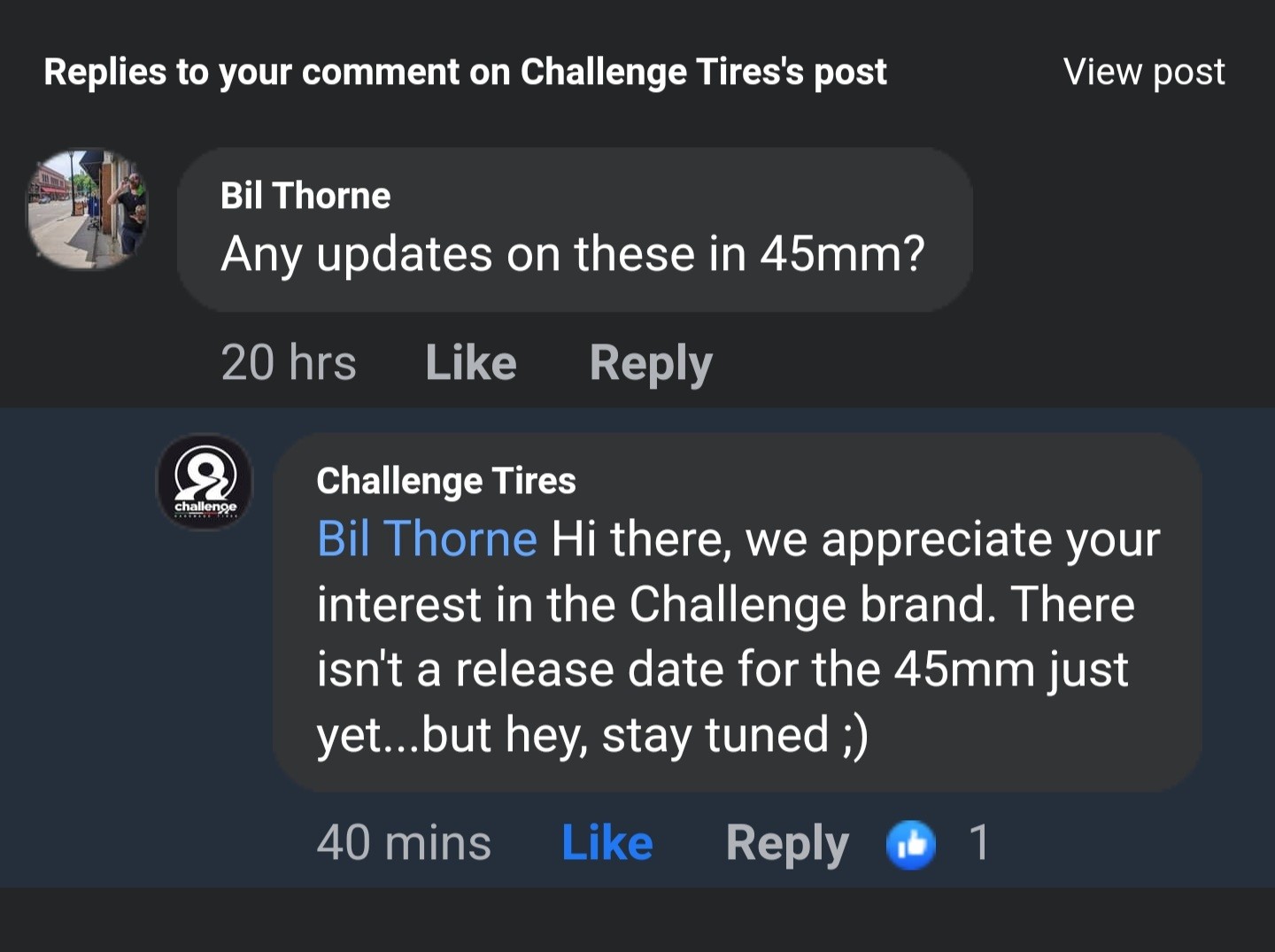
For me the great comfort, low rolling resistance, good handling, relatively light weight, and long life make the SBP my favorite tire for riding mostly on pavement. I expect the forthcoming 45 mm version will be better on dirt and gravel.
I just got a set of these in 40mm. What’s interesting is that the bead to bead length is the same length as 43mm Gravelkings yet they only are 41mm mounted vs 44mm for the GK. I guess the casing doesn’t stretch as much under pressure. Mounting required using zip ties but was not too hard. I guess I’ll need to carry a couple zip ties for roadside repairs. I could inflate them with a regular floor pump. I had read reviews that these could not be used on hookless rims, perhaps Challenge changed their recommendations. The included instructions said tires that stay below 5.5 bar (about 80psi) can be used on hookless rims, the 40mm tires have a max pressure of 4.5 so they are good to go on hookless rims.
FWIW Mavic publishes a tire/rim/pressure chart which includes both hooked and hookless rims. For a 40 mm tire their maximum pressures are: 19 mm hooked rim: 6.00 bar 19 mm hookless rim: 4.80 bar 22 mm hooked rim: 5.30 bar 22 mm hookless rim: 4.25 bar 25 mm hooked rim: 4.75 bar 25 mm hookless rim: 3.80 bar
Those work out to subtracting 20% for hookless rims.
I asked Challenge a while ago and they comfirmed their HTLRs are hookless compatible in CX sizes and up. Google searches show an older Bikerumor.com article that says otherwise, which I guess was just before Challenge's testing/certification.
DKeane wrote:Seems like we are generally talking tubeless capacity. For luddites like me that still use tubes, I suspect the hookless discussion is moot.
Good point about tubes. I can't find the original article the chart came from ( engineerstalk.mavic.com seems to be gone) and I don't remember if those numbers were for tubes or tubeless. It might be a good idea to take another 20% off those pressures for tubeless. Anyway here are the charts:
One feature I find interesting is the huge difference (more than 20%) in pressures between 40 and 42 mm tires. Again I remember no explanation but I'm guessing that's where they drew a line between road and MTB tires.
Personally I'm not worried. I use tubes, hooked rims, and pressures way below those listed in the above charts.
Why do companies get people excited for their product and then not deliver? I would have definately tried one of these but ended up just buying another Speedking Racesport--which admittedly, is probably faster and has a lot more volume. I was thinking about the 45mm tire for the front on my climbing, rough road bike.
Volsung wrote:You see Tubolito makes a new tube they're claiming to be flatproof?
I bought a pair of those and installed them in 45 mm Pirelli Gravel H tires but then got COVID-19 and couldn't ride for 5 months. When I got back on the bike I rode for a while with the wheels which were on the bike with SBP tires. Last week I swapped the wheels and on my 3rd ride got a glass shard about 5mm long in the back tire. It went right through the tire (as has been my experience with the Gravel H) and put a pretty good hole in the tube. So much for flatproof.
I love the feel of the Gravel H but won't be riding those on the street any more. I found a pretty good price on the new Schwalbe Marathon Efficiency so I'm going to try a pair of those (40 mm) for situations where I want something bigger and tougher than the SBP.