Noonievut wrote:I have GKSK 48mm for gravel, dirt and mixed surface. They’re good on pavement, but I’m looking for a faster tire on paved roads.
I tour now and then on the same bike, and other than smooth rail trails those rides are mainly on paved roads. I want to keep high volume for a supple ride over rough roads.
I know of the WTB Horizon, Compass and a Panaracer slick (all around 47-48mm).
Any recommendations?
I apologize for being late to this party...
I only have direct experience with the 700C 38mm Gravelking slicks, mounted to older, narrow Mavic Aksium wheels (stock wheels for a ~2010 CX bike, with about 15mm inner width). I toured on the 38mm GK Slick for a few hundred miles in Italy this spring, on my 1980s steel touring bike, running rear panniers only. Tires were mounted with heavy-ish tubes (Slime Lite, ~150g each), instead of tubeless.
Over the years, I have become a fan of riding the widest tires I can fit into most of my bikes, whether mountain or road bikes, simply because fatter tires usually provide better traction and/or comfort.
And since I mounted these this spring, I absolutely love the 38mm Gravelking Slick tires and can't say a bad thing about them. Their ride quality is super cushy--so cushy that the upper body fatigue I was used to feeling in my hands/arms/shoulders/neck from road buzz and vibration after a few hours of riding previously on a myriad of 25mm to 32mm tires, was pretty much gone or at least significantly diminished. And I was never really fully aware of this effect on my upper body until I started riding the 38mm GK Slick--after completing my usual 2-3 hour road rides, I wouldn't feel nearly as worked, stiff, or as tired as I had when riding narrower tires with higher pressures.
As a point of reference, my carbon road bike had
tires with low rolling resistance (25mm GP4000S II tires), mounted to
wheels with low aero resistance (AForce Al33 wheels have about same aero resistance as Zipp 303 Carbon Clinchers), before it got stolen. Anyway, despite the GK Slick's 38mm width, and claimed ~320g weight, it's no slouch on the road. It rolls fast. By comparing times for one of my typical training loops, they're not quite as fast as the GP4kSII (but then again it's not quite an apples to apples comparison, as I'm comparing loop times for a much lighter carbon roadbike to a heavier steel touring bike). Regardless, I suspect the 38mm GK Slick's rolling resistance is pretty low for it's size.
I also suspect their casings are thin (given their weight), as well as supple (given their ride quality). So it would be interesting to compare the construction of Gravelking Slicks to similar Compass tires (both Standard and Extralight versions) and Soma's Supple Vitesse tires (both SL and EX versions), since all of those tires are made by Panaracer--i.e., how similar are their casings, sidewall compound & thickness, and tread compound & thicknesses?
And where do these tires lie relative to each other on the spectrum of light/supple/fragile on one end, to heavy/stiff/durable on the other? Noonievut wrote:Would the Compass, Panaracer or similar tire be as good on wet pavement as the 25mm Gatorskins I use on my road bike? Not to say they’re great rain tires, but they’re predictable and I’ve always maintained traction through turns on wet roads.
I will be using with tubes, as they will be swapped with other tires on one set of rims.
As others have said, traction on wet pavement depends on several factors, including tire width, rim width, air pressure, tread compound, casing suppleness, etc. Tread pattern for road tires has been debated in the past, and
engineer-oldschool-roadie-guru Jobst Brandt argued 2 decades ago that slick, round tires provide the most grip and friction for bicycles cornering on wet roads, because the bike's tire is so narrow that it completely displaces any amount of water on the road surface to contact the road's pavement underneath; and any tread ridges or knobs on a relatively narrow road bike tire will likely only serve to squirm and decrease traction. Whether that's true or not (or maybe the more accurate question to ask is "under what conditions would that not hold true?"), I'll defer to engineers to support or rebut Jobst's assertion.
Anyway, my experience riding the Gravelking Slick (which actually does
not have a smooth tread like a traditional road racing tire, but has a center tread section consisting of a fine file-tread or subtle raised dimple pattern, with fine herringbone/chevron treads on the shoulders) down a twisty mountain road in a rainstorm is purely anecdotal.
Near the end of what turned out to be the biggest day of our Italian tour, we found ourselves at the top of a mountain pass, dotted with lingering stashes of snow, staring straight into a quickly approaching storm. Looking down at our destination town in the valley floor beneath us, we realized that it was gonna be a race, pitting us against a huge late spring deluge, to see if we could descend ~2900 feet of twisty mountain road that hadn't yet been cleared of snow or storm debris, to reach the town of Capistrello first, before the storm hit.
So, prior to gazing at the awesome view in front of us, we spent the better part of the day climbing ~5000 feet in the preceding ~50 miles, ascending and descending several ridgelines from the Lazio region into the Abruzzo region, lugging all of our gear in our overstuffed panniers, had already endured 1 downpour (which was precisely when 1 of our group
not riding on Gravelkings suffered a flat), and were not exactly mentally prepared for snow (albeit in small patches), since we weren't anywhere near the Alps (in fact, we were south of Rome) and it was nearly June (!).

Despite wearing multiple layers of the warmest clothes we carried, we were shivering cold just standing still. And we were all feeling pretty worked by the day's climbing. And to top it off, as I started my descent, I realized that my rear brake was essentially useless--and looking back, I'm pretty sure my rear brake cable slipped through its pinchbolt during the white knuckle descent from Jenne into the valley of some National Park (only to have to climb many, many, many switchbacks up out of that valley). So the prospect of outracing the storm by bombing 2900 feet as fast as I dared, around the crappy, wet, narrow road that snaked its way down the mountainside, all while trying to avoid having my front tire wash out by cautiously feathering my surviving brake to scrub speed as I dodged patches of slush, gravel, dirt and the occasional boulder, inspired about as much confidence as the foot protection provided by my open-toed cleated sandals (which had become my standard touring footwear for 10+ years, since they're so comfy in hot summer weather).
Somewhere during my auspicious descent...
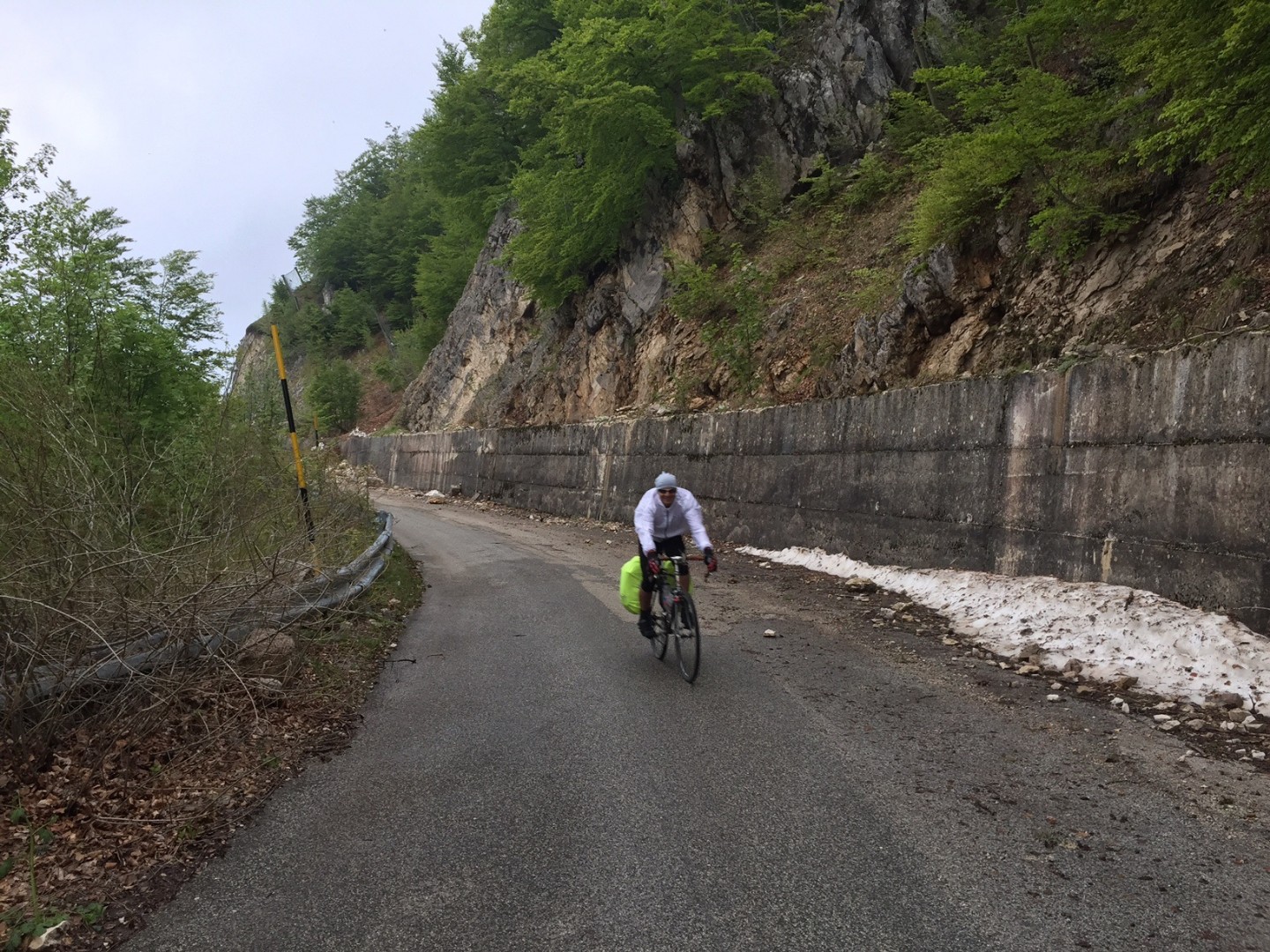
So did we outrace the storm? Close. Well, not really--the storm beat us before we got into the valley, breaking loose and flooding us from above, as we nearly made it with only a few more switchbacks to navigate. And how did those 38mm GK Slicks do? I'm very grateful to report that they were as solid as a rock, and held their grip the entire descent. I never once felt them lose traction on pavement, no matter how bad the conditions were.
After descending that twisty mountain road in crappy conditions on a ass-end heavy touring bike with only a front brake (and likely riding way faster than I should have in spots), I wouldn't even hesitate to ride an unloaded bike (or a more evenly weighted touring bike), with a functioning
pair of brakes, more aggressively in similarly bad conditions on those GK Slick 38s. And on the days when we dumped our panniers and left them in our hotel rooms to ride unencumbered, we did exactly that (there was an abundance of mandatory aggressive urban riding while battling a sea of cars and scooters through downtown Naples, as well as lots of steep fast road riding in the Tuscan hills north of Florence) and they felt both surprisingly fast and super plush--nothing at all like a typical touring tire, such as a 32mm Pasela or Marathon Supreme. And for the 2 out of 4 of us who were riding 38mm GK Slicks during that tour, we suffered no flats (with our Slime tubes) despite heavy loads and sometimes less than smooth tarmac.
So for what you described, I think the 48mm 27.5" GK Slicks would be perfect, regardless of whether you are touring or riding unloaded. But they would
not be my first choice if I was doing an extended tour through a remote region, and needed an absolutely bombproof pair of tires to see me safely through several weeks or more of riding, and the opportunity to buy replacement tires if necessary was few and far between.
Presuming all things are equal, would the 48mm Compass Switchback Hill or 48mm Supple Vitesse SL or EX perform any better than a 48mm GK Slick? I dunno, but if they do, then hats off to them because the 38mm GK Slick is a pretty awesome road tire in my opinion.
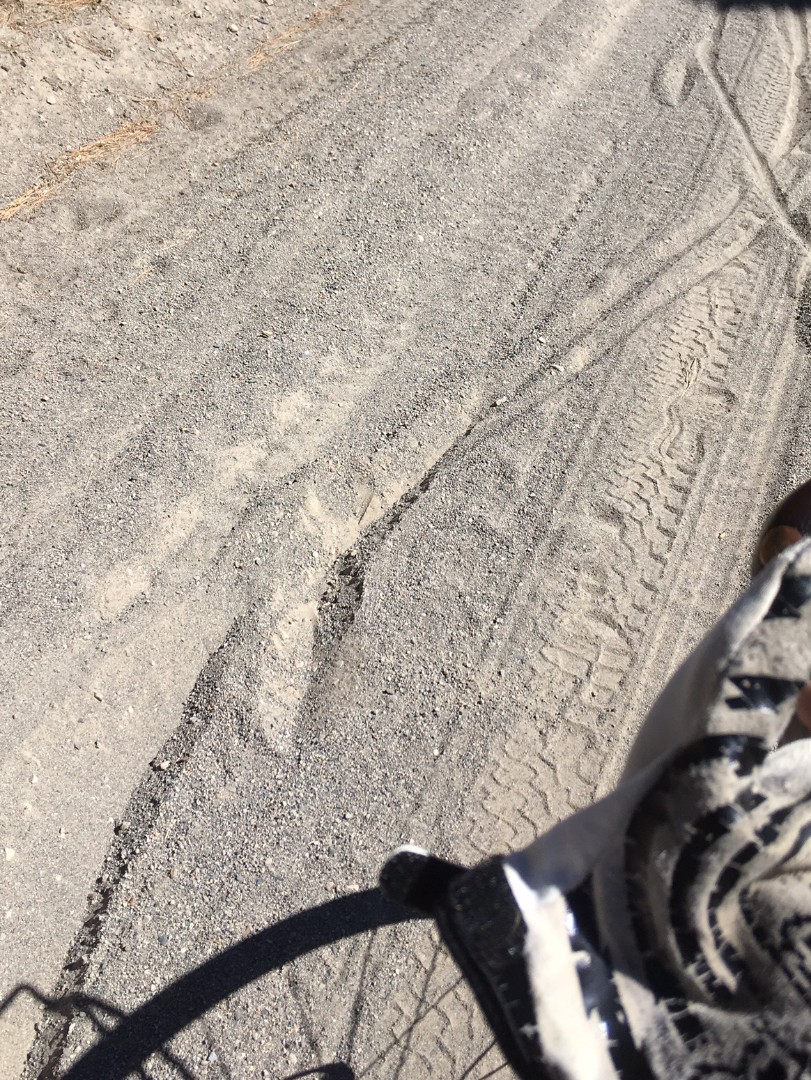
Offroad? The 38mm GK Slick actually does surprisingly well on any firm, compacted surface, and the firmer the better, despite a lack of knobs. But as soon as the road or trail gets soft and loose, they get squirrely as expected. I quickly reached their limit of traction in loose, sandy aggregate that was about 1/4" and finer, and was about 2-4" deep (with occasional deeper pockets), like this stuff:
And as far as longterm durability, I can't really comment yet, since I ride my mountain bike way more than my touring bike, and probably have < 1000 miles on the GK Slicks. They're light, and apparently have a thin rubber tread to keep their weight down, so they probably won't last too long. But even if they wear out quickly, I will gladly keep buying them because their ride quality is so good, and they're less expensive than their competition. On the other hand, if Compass tires or Soma's Supple Vitesse EX have a similar supple, fast feel, and also last significantly longer, then I'd consider a pair of those instead.